



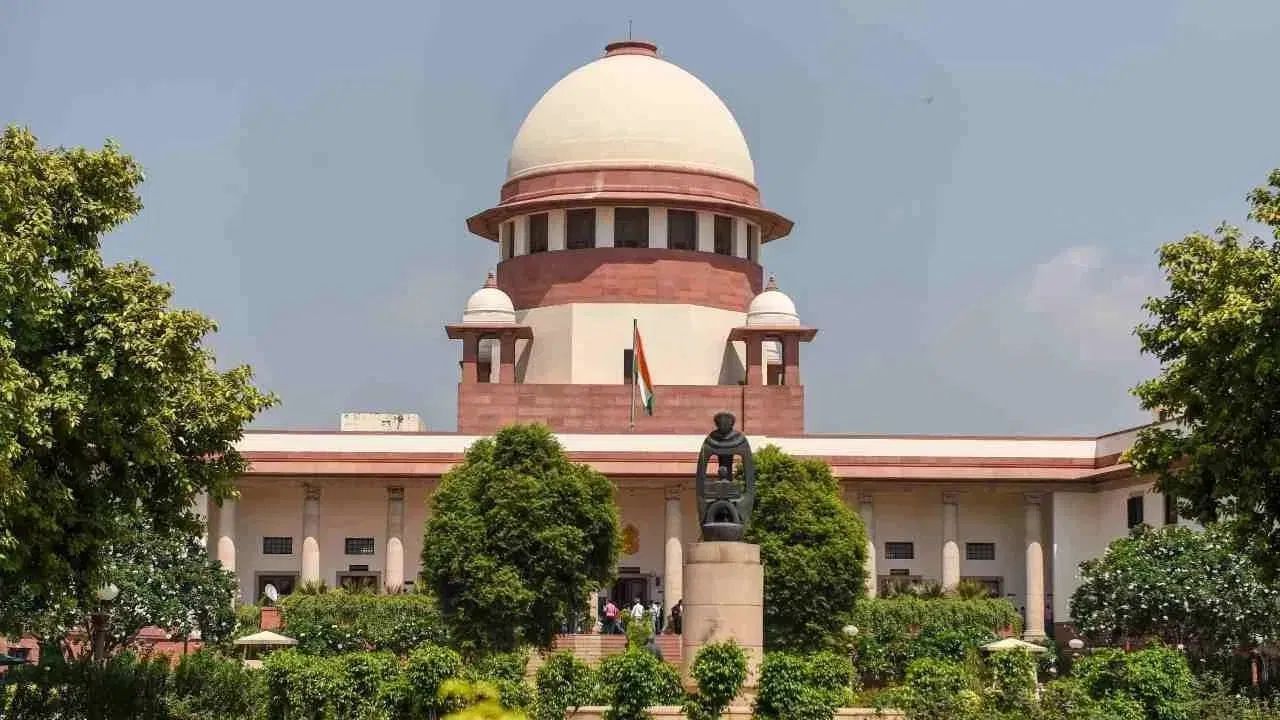
Disagreements between governors and state governments have frequently come to light. Complaints of governors acting arbitrarily have arisen in states including West Bengal, Tamil Nadu, Karnataka, Punjab, and Delhi. The Supreme Court is hearing a Presidential Reference. The central government has responded to this dispute for the first time. The Chief Justice stated that the framers of the constitution intended for a harmonious relationship between governors and state governments.
On the 10th day of the Supreme Court proceedings, the central government presented its arguments on the governor’s powers regarding bills, stating that governors can withhold unconstitutional bills and send them back for reconsideration. Solicitor General Tushar Mehta, refuting the arguments of the Punjab government, clarified that the governor has discretionary powers beyond just giving assent to a bill.
The central government clarified how governors order reconsideration. Solicitor General Tushar Mehta clarified that when returning a bill for reconsideration, the governor also makes a formal declaration not to give assent. The governor’s message, sent with a bill returned under Article 200, Clause 1, will determine the scope of reconsideration.
Solicitor General Tushar Mehta also clarified that the original bill number will remain the same for bills reconsidered and returned to the governor for approval in the same year. However, if the legislature reconsiders the bill the following year, the bill number will be different.
The central government refuted the Punjab government’s argument. The central government stated that the governor has no discretion beyond declaring a bill invalid. SG refuted the argument of Punjab government’s lawyer, Arvind Datar. He said that even if a bill is invalid, the governor has no discretion other than to approve it. The SG presented some examples.
The central government told the court that the governor can block bills that are clearly unconstitutional. SG Tushar Mehta, representing the center, told the SC that while interpreting constitutional provisions under sections 200 and 201, the court should consider the extreme and dangerous situations that could arise in the future of the nation. Therefore, the court should adopt a cautious approach.
Governors are considered part of the legislature – the center. The claim by opposition states that the powers of consent are executive in nature is fundamentally incorrect. Solicitor General Tushar Mehta further stated that the governor’s consent is part of the legislative process. Consent is semi-legislative or self-specific in nature.
The claim by opposition states that the powers of consent are executive in nature is fundamentally wrong. However, the executive can assist in the creation of a bill, which can be presented before the legislature. Once the process is complete, the process is legislative in nature until consent is granted. This is why the governor is considered a part of the legislature.
What did the Chief Justice say about the whole matter? Chief Justice of India (CJI) B.R. Gavai said that when the constitution makers were considering the position of governors, it was hoped that it would be a harmonious existence. CJI B.R. Gavai added that the provincial governments (now states) were usually involved when appointing governors.
What exactly is a Presidential Reference? The Indian Constitution gives the President several powers, including the ability to directly order state governments and the central government, apart from the Supreme Court. Article 143 of the Constitution addresses Presidential References. It is completely different from the normal process. If the President feels that an issue is legally or publicly necessary, the President may seek advice from the Supreme Court on any law or constitutional issue.
On April 8, the Supreme Court, while delivering its verdict on the Tamil Nadu governor case, had said that the governor could not withhold bills indefinitely. Following this, the President ordered a Presidential Reference.