



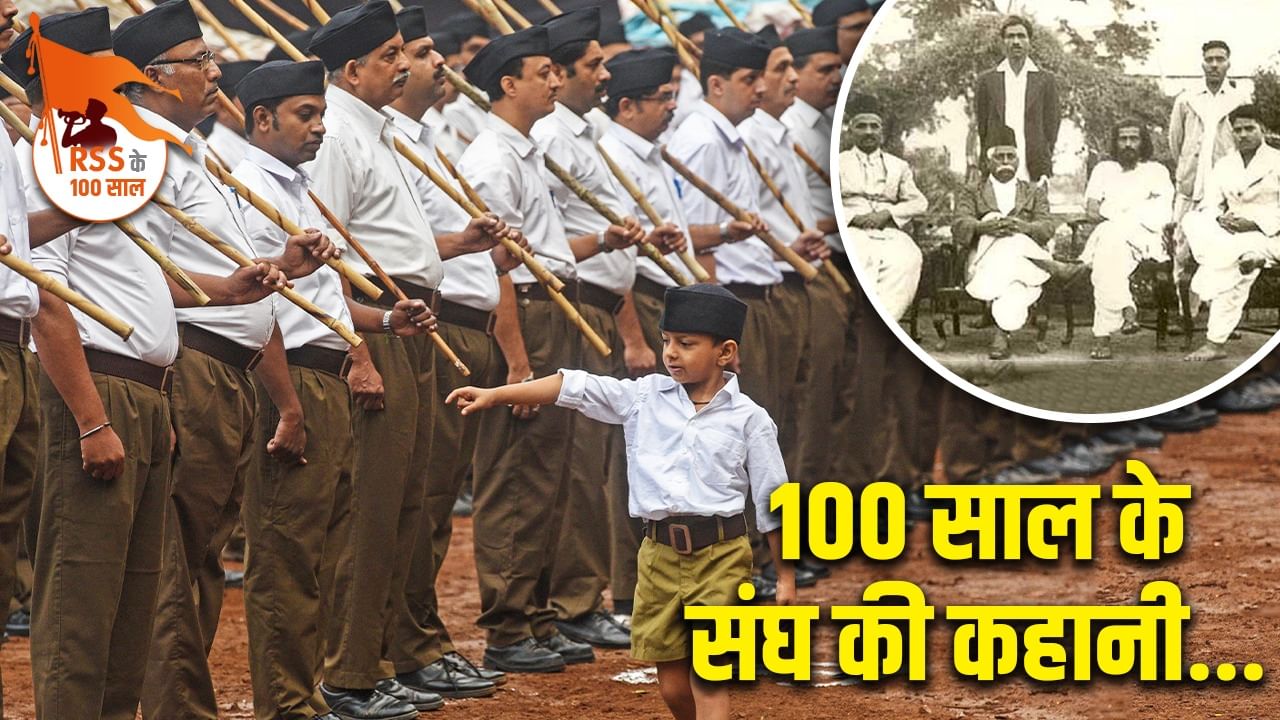
On September 27, 1925, in Mohite’s Wada, Mumbai, Dr. Keshav Baliram Hedgewar, along with five volunteers, laid the foundation of the Rashtriya Swayamsevak Sangh (RSS). Many initially mocked Hedgewar, dismissing his efforts as an attempt to incite a revolution with children. However, few could have foreseen that this small group of six would evolve into one of the world’s largest voluntary and Hindu organizations.
The RSS is approaching its centenary. Today, the RSS boasts over 75,000 branches across the country. The organization claims to have over 10 million trained members. Furthermore, the Sangh Parivar includes more than 80 affiliated organizations. The RSS’s influence extends to approximately 40 countries, highlighting its global reach. Currently, over 56,000 daily branches are conducted, along with around 14,000 weekly and 9,000 monthly branches.
Let’s delve into the story of the RSS’s establishment and expansion.
### From the Khilafat Movement to the Foundation of the Sangh
The year was 1919, and World War I had ended. The once vast and powerful Ottoman Empire of Turkey was crumbling. The British had removed the Caliph of Turkey, whom Muslims worldwide considered their religious leader. This news spread rapidly, igniting anger among Muslims globally. In India, which was itself struggling under colonial rule, Muslims took to the streets.
This sparked the Khilafat movement, led by the Ali brothers, Shaukat Ali and Mohammad Ali. Their goal was to restore the Caliph to the throne of Turkey. The movement gained momentum, drawing in millions.
Meanwhile, the situation in India was already volatile. The Jallianwala Bagh massacre was fresh in people’s memories. Martial law was in effect in Punjab, and the Rowlatt Act had fueled public outrage. At the same time, Mahatma Gandhi, returning from South Africa, was preparing a large-scale mass movement. He believed the Khilafat movement could serve as a bridge for Hindu-Muslim unity. Gandhi stated,
‘Just as the cow is revered by Hindus, the Caliph is revered by Muslims.’
### Hedgewar Disagreed with Mahatma Gandhi’s Views
Gandhi’s view did not resonate with everyone. Dr. Keshav Baliram Hedgewar, a young Congressman from Nagpur, disagreed with Gandhi’s opinion. He believed that putting religion above the nation was dangerous. Despite his reservations, he joined the movement at Gandhi’s urging and was even jailed for his fiery speeches.
In 1921, when the movement reached Malabar, Kerala, the situation deteriorated. Conflict erupted between Muslim farmers and Hindu landlords, escalating into violent clashes. Over two thousand people were killed. Dr. B.R. Ambedkar wrote in his book, ‘Thoughts on Pakistan,’ that forced conversions and the destruction of temples occurred during this violence. Annie Besant also questioned Gandhi and wrote an article in a newspaper stating that if Mahatma Gandhi had visited Malabar, he would have seen the consequences of his decisions.
Hedgewar was deeply affected by these events. He felt the need for a separate organization for Hindus. He also joined the Hindu Mahasabha but soon became disillusioned. He felt that the organization was mired in political compromises and would not truly protect Hindu interests.
### The Sangh’s Foundation on Vijayadashami
Then came the historic day – September 27, 1925. On the special occasion of Vijayadashami, Hedgewar invited five companions to his home. The meeting included Ganesh Savarkar, the brother of Vinayak Damodar Savarkar, Dr. B.S. Munje, L.V. Paranjpe, and B.B. Tholkar, along with Hedgewar. At the meeting, he declared that they were starting the Sangh. This marked the beginning of the Rashtriya Swayamsevak Sangh (RSS).
In the early days, members met only twice a week. They exercised on Sundays and discussed national issues on Thursdays. These meetings were called shakhas. These shakhas became the identity of the Sangh. On April 17, 1926, the organization was formally named the Rashtriya Swayamsevak Sangh. That same year, on Ram Navami, the volunteers appeared in uniform for the first time: khaki shirts and pants, caps, and boots. This display of discipline and uniformity quickly became a hallmark of the Sangh.
Soon after, regular shakhas began from Mohite’s Wada ground in Nagpur. This was the point from which the Sangh gradually expanded and made its mark on Indian society and politics.
### Hedgewar’s Vision Expanded the RSS’s Reach
Dr. Hedgewar had a unique way of connecting with young people. He would advise students passing their matriculation exams not to be limited to Nagpur but to study in other cities. There, they were encouraged to start a shakha in their college and involve their classmates in the Sangh. This is how the Sangh’s message began to reach new cities and colleges. During the holidays, when these students returned to Nagpur, Hedgewar would specifically ask them how their shakhas were progressing, how many people were joining, and what difficulties they were facing. This gave him an understanding of how the shakha activities were unfolding outside.
The first RSS branch outside of Maharashtra was established in Varanasi in 1930. This shakha later became very special because it was through this that the second Sarsanghchalak, Guruji (Madhav Sadashivrao Golwalkar), joined the Sangh. Furthermore, Hedgewar himself would visit the homes of those boys who did not attend the regular shakhas. He would converse with them openly, meet their families. Many families, influenced by his simplicity and words, began sending their children to the shakhas themselves. Gradually, this influence grew so much that new volunteers joined the Sangh every month. Thus, the shakhas were not limited to Nagpur but began to spread across the country.
### The Deaths of Three Sarsanghchalaks While in Office
From 1925 to the present, there have been six Sarsanghchalaks in the Rashtriya Swayamsevak Sangh. Dr. Hedgewar, who founded the RSS, held his responsibilities from 1925 to 1940. After Dr. Hedgewar’s death in 1940, Madhav Sadashivrao Golwalkar was given this responsibility. People called him Guruji. Golwalkar held the position from 1940 to 1973. After his death in 1973, Madhukar Dattatreya Deoras became the Sarsanghchalak. Most people knew him as Balasaheb Deoras. In 1993, Professor Rajendra Singh, also known as Rajju Bhaiya, took over the position. However, in 2000, Rajju Bhaiya, due to health reasons, handed over the post of Sarsanghchalak to Kripahalli Sitaramayya Sudarshan while he was still in office. In 2009, Sudarshan also handed over his responsibilities to Dr. Mohanrao Madhukarrao Bhagwat (Mohan Bhagwat), making him the new head of the Sangh due to health concerns.