



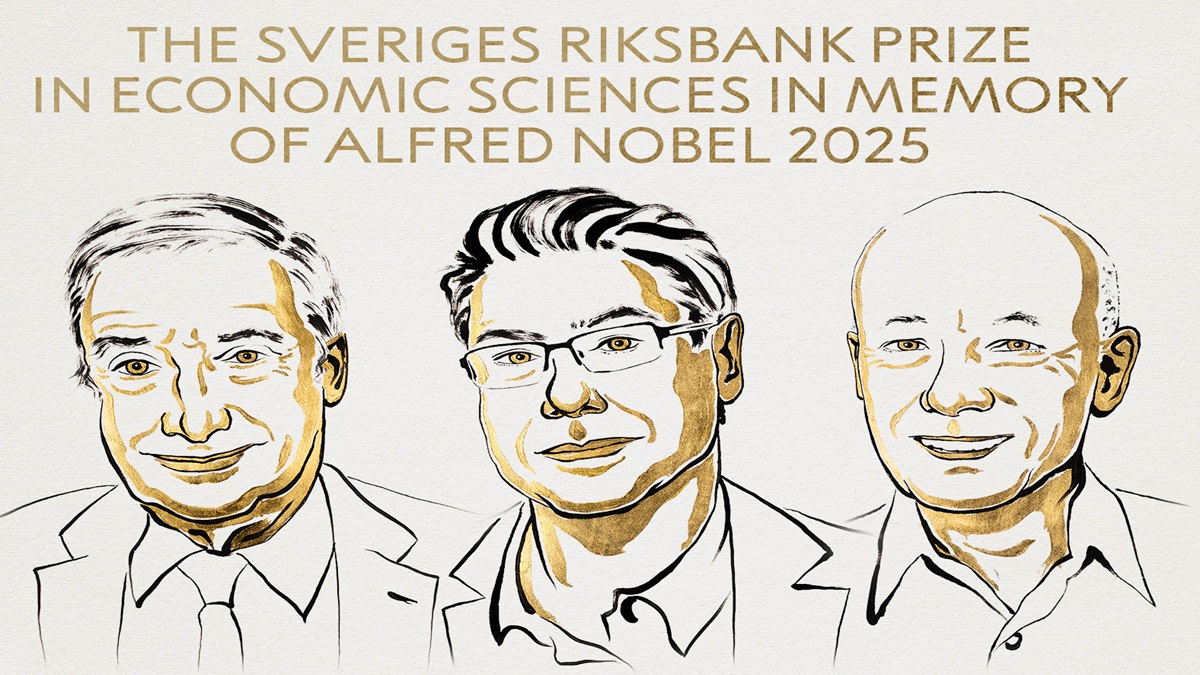
The prestigious Nobel Prize in Economic Sciences has been awarded to Joel Mokyr, Philippe Aghion, and Peter Howitt for their groundbreaking work explaining innovation-driven economic growth. This year’s award recognizes Mokyr for his insights into the prerequisites for sustained growth through technological advancement, while Aghion and Howitt share half the prize for their influential theory on economic expansion driven by “creative destruction.”
The Nobel committee highlighted Mokyr’s research, emphasizing that for innovations to continuously emerge, a deep scientific understanding of their underlying principles is crucial, not just a knowledge of their functionality. Mokyr is affiliated with Northwestern University. Aghion, from the College de France and the London School of Economics, and Howitt, from Brown University, developed a mathematical model in 1992 illustrating creative destruction. This economic phenomenon occurs when superior new products displace older ones, leading to market disruption and renewal.
Experts note that the laureates’ research underscores the dynamic nature of economic growth, suggesting that fostering the processes of creative destruction is vital to prevent economic stagnation. This stands in contrast to last year’s recipients, who explored the reasons behind national wealth disparities, concluding that open societies tend to flourish.