


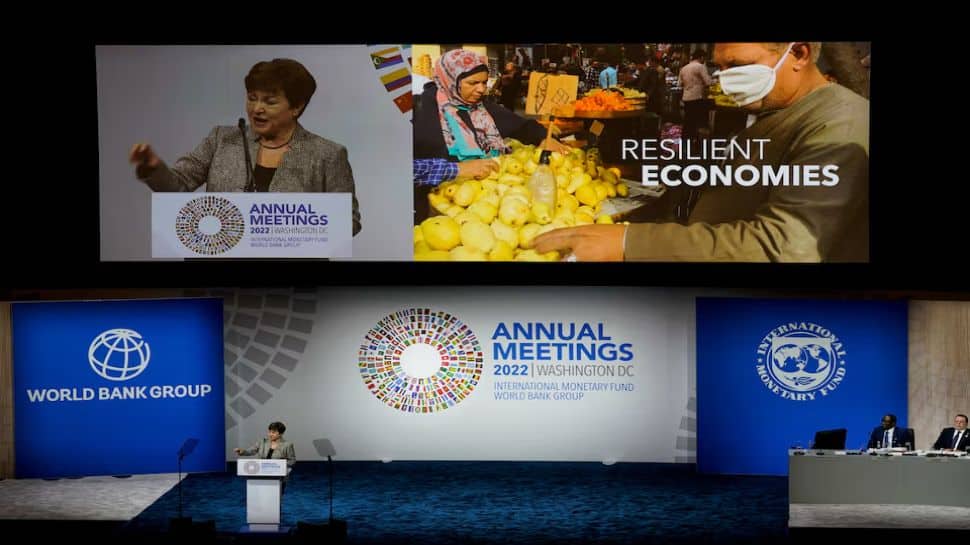
Argentina, Ukraine, and Egypt are the largest debtors to the International Monetary Fund (IMF) in 2025, collectively owing close to half of the $162 billion in outstanding loans. This significant debt burden was highlighted during recent IMF and World Bank meetings in Washington, D.C., attended by global financial leaders. The discussions centered on how these substantial debts affect international economic stability, effective debt management, and strategies for supporting countries in severe financial distress. The IMF has also issued warnings about potential financial instability, exacerbated by factors like U.S. trade tariffs and growing global protectionism.
The IMF acts as a crucial ‘lender of last resort,’ stepping in to assist nations facing acute financial crises when conventional borrowing avenues are blocked. While these loans provide vital liquidity, they often come with stringent conditions, including austerity measures that can lead to considerable economic and social hardship, presenting a complex challenge for recipient countries.
The IMF, established in 1944 at the Bretton Woods Conference, aims to foster global economic stability. It has evolved from 44 founding members to 191 nations today and collaborates with the United Nations to achieve its objectives. The organization offers policy advice, financial aid, and capacity development. Membership requires approval from existing members, and contributions are based on a country’s economic size, which also dictates borrowing limits and voting power. The IMF’s total lending capacity is approximately $1 trillion, funded by member nations, with wealthier countries acting as creditors and earning interest on their contributions.
As of October 15, total IMF credit outstanding reached a record high of SDR 118.9 billion (approximately $162 billion), owed by 86 countries. Argentina leads with SDR 41.8 billion ($57 billion), followed by Ukraine at SDR 10.4 billion ($14 billion), and Egypt at SDR 6.9 billion ($9 billion). These top three nations account for nearly half of the total IMF debt, with the top ten debtors representing 73 percent.
Argentina’s substantial debt stems from its continuous reliance on IMF support, having received its 23rd program recently, a $20 billion bailout aimed at economic stabilization. Historically, Argentina secured the largest loan in IMF history in 2018 ($57 billion) to address fiscal imbalances and a currency crisis. Further financial support was announced in October 2025 by the U.S. administration, including a $20 billion currency swap to bolster reserves.
Ukraine’s significant debt, exceeding $14 billion, is a direct consequence of the economic devastation caused by the 2022 Russian invasion. Its external debt has more than doubled, reaching $152 billion by April. A four-year Extended Fund Facility (EFF) worth $15.5 billion was approved in March 2023 to stabilize its economy amidst high military spending. As of October 2025, Ukraine had received $10.6 billion of this amount.
Egypt’s third-highest debt position is attributed to recurring borrowing to manage its economic challenges, characterized by high deficits, low foreign reserves, and elevated inflation. Previous IMF programs, including an $11.9 billion EFF in 2016, aimed to address structural issues. A more recent $1.2 billion disbursement in March 2025 followed a review of an $8 billion reform program, showing signs of economic stabilization.
While these IMF loans represent billions, they often constitute a small portion of a country’s total debt and GDP. However, for some nations, the IMF debt-to-GDP ratio is notable, with Suriname (13%), Central African Republic (9.4%), Argentina (8.3%), Barbados (7.4%), and The Gambia (6.95%) having the highest proportions.