




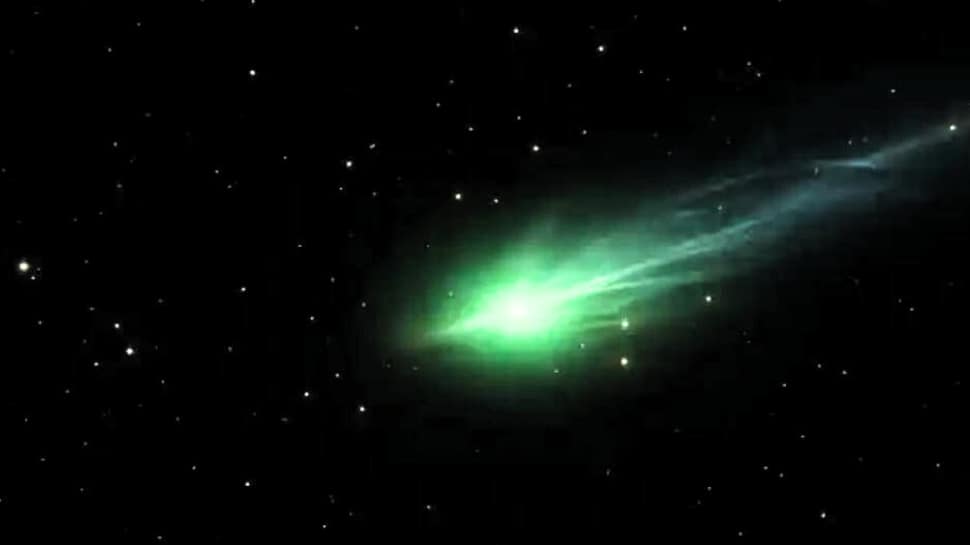
The interstellar comet 3I/ATLAS, initially expected to disintegrate, has astonished scientists by surviving a close solar pass. First detected in July 2025, this enigmatic visitor from deep space continues to defy predictions with its striking blue-green glow and a tail extending over a million kilometers. Its most recent feat was emerging intact after swinging behind the Sun in November, a maneuver that typically spells doom for comets. This remarkable survival has revitalized debate, particularly involving Harvard astrophysicist Avi Loeb.
Loeb, known for his unconventional theories on extraterrestrial technology, points to new images from the Nordic Optical Telescope. These visuals, captured on November 11, show 3I/ATLAS as a cohesive entity, free from fragmentation. Loeb contends that the observed mass-loss jets emanating from the comet are disproportionately powerful for a natural object of its size. He calculates that the necessary absorbing surface area to generate such jets would be significantly larger than Manhattan Island, a scale he deems impossible for a typical comet nucleus based on available data.
His analysis, detailed on Medium, highlights a substantial energy discrepancy. The Sun’s energy output at perihelion, he states, is insufficient to explain the observed jets unless the comet possesses an absorbing area exceeding 1,600 square kilometers. This paradox leads Loeb to question its natural origin, suggesting it might be an artificial construct. He also notes unusual features like an anti-tail, which points towards the Sun, adding to the mystery.
Loeb proposes a provocative idea: the comet’s jets could function as ‘technological thrusters,’ a propulsion system to accelerate the object after its solar encounter. This would be analogous to a spacecraft using a maneuver to gain speed rather than lose it. He posits this could also explain its survival through the intense solar heat.
However, not all scientists share Loeb’s view. Darryl Seligman, an astronomy professor at Michigan State University, dismisses the artificial hypothesis. He argues that 3I/ATLAS’s resilience is well within the capabilities of a large, natural comet nucleus, estimated to be around 1 km in diameter. Seligman suggests Loeb may be overestimating the comet’s mass-loss rates and jet dimensions.
Further complicating the narrative, the MeerKAT radio telescope in South Africa detected radio absorption lines from hydroxyl radicals on October 24. This signal, a result of water molecules breaking apart under sunlight, is a strong indicator of a natural, water-rich comet expelling material. The detection, absent in earlier September observations, supports the natural comet explanation.
As conflicting interpretations emerge, 3I/ATLAS remains an astronomical enigma. Whether it’s a robust comet or a sophisticated alien artifact, its journey has pushed the boundaries of our understanding of celestial objects and secured its status as a significant discovery.