


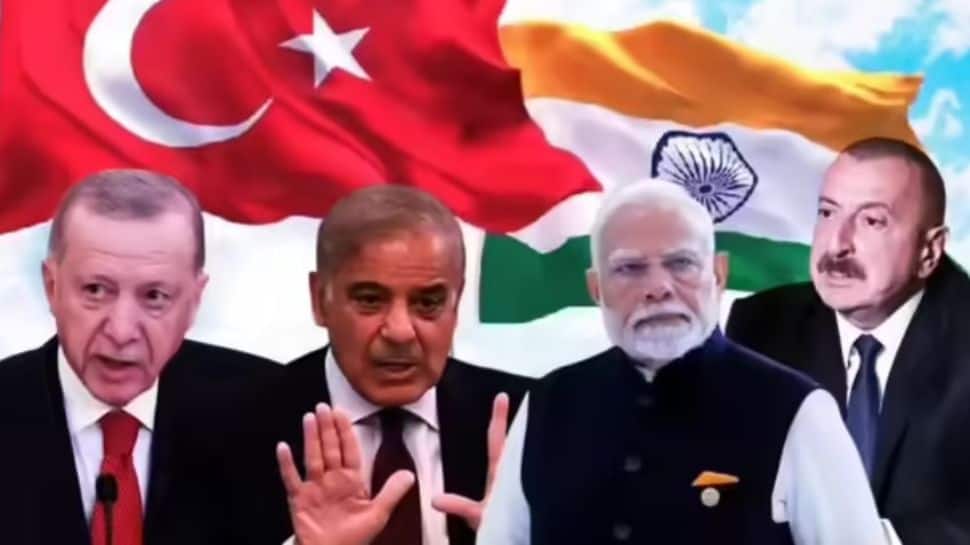
Recent months have seen a significant escalation in geopolitical tensions between India and a growing alliance involving Turkey and Azerbaijan. This antagonism stems from a complex interplay of historical allegiances, regional aspirations, and evolving global dynamics. While economic ties exist, both Turkey and Azerbaijan are increasingly adopting stances that clash with India’s strategic interests.
Turkey’s support for Pakistan has become particularly pronounced, especially after India’s decisive ‘Operation Sindoor’ in early May. Following a terror attack in Jammu and Kashmir, India conducted strikes against nine terrorist targets within Pakistan-administered territory. Ankara strongly condemned these actions, warning of potential conflict and expressing solidarity with Pakistan’s Prime Minister. Turkish President Recep Tayyip Erdoğan reportedly lauded Pakistan’s response and offered diplomatic assistance.
In response, India’s Ministry of External Affairs called on Ankara to curtail its backing of cross-border terrorism and take demonstrable action against the terror networks it is accused of sheltering. This exchange highlights the deepening strategic alignment between Turkey and Pakistan.
The Turkey-Pakistan axis is bolstered by historical and ideological commonalities, often framed as ‘Islamic solidarity.’ Ankara has consistently supported Pakistan on the Kashmir issue, positioning itself as a proponent for Muslim-majority nations. This ideological affinity translates into tangible military cooperation, with Turkey supplying Pakistan with advanced drones, including Asisguard and Songar models. India has reported the use of hundreds of Turkish-made drones by Pakistan in attempted infiltrations, citing serious sovereignty violations. The recovery of a Turkish kamikaze drone in Jammu and Kashmir further underscores the concern over foreign military hardware fueling regional hostilities.
Azerbaijan has also aligned itself with Pakistan, condemning India’s military actions and advocating for a diplomatic resolution. This diplomatic stance is underpinned by a robust strategic alliance solidified by the 2021 Shusha Declaration between Turkey and Azerbaijan. This pact includes joint defense initiatives, military exercises, and plans to develop Azerbaijan into a regional defense production hub, alongside infrastructure projects like the “Middle Corridor.”
Baku’s opposition to New Delhi is significantly influenced by its conflict with Armenia over Nagorno-Karabakh. India’s growing defense ties with Armenia, including the supply of weapons systems, directly irk Azerbaijan, creating a geopolitical fault line.
The emergence of a trilateral framework, sometimes dubbed the ‘Three Brothers’ alliance between Turkey, Azerbaijan, and Pakistan, poses a direct challenge to India’s strategic positioning. This bloc engages in joint military exercises, mutual support in international forums, and backing of each other’s territorial and ideological claims.
The consequences for India are becoming increasingly tangible. Public sentiment has seen a backlash, with calls for boycotts and cancellations of travel to Turkey and Azerbaijan following their support for Pakistan. Economically, India revoked the security clearance of a Turkish airport services firm, citing national security. On multilateral platforms, India has indicated that bilateral ties with Turkey must respect its core concerns, referencing Ankara’s defense cooperation with Islamabad. Azerbaijan, in turn, has accused India of obstructing its bid for full SCO membership, viewing it as retaliation for supporting Pakistan.
This tripartite alignment serves strategic imperatives for all involved. For Turkey, it enhances its influence in the Muslim world and counters regional rivals. For Azerbaijan, it strengthens alliances and pushes back against India’s growing footprint in the South Caucasus via Armenia. From India’s perspective, this bloc represents a concerted effort to contain its influence across South Asia and beyond.
The opposition from Turkey and Azerbaijan is rooted in a combination of historical ties, ideological alignment, and geopolitical ambitions, institutionalized through declarations and joint ventures. As India recalibrates its own alliances, notably by strengthening ties with Armenia, the tension with the Turkey-Azerbaijan axis remains a significant and growing strategic concern.