




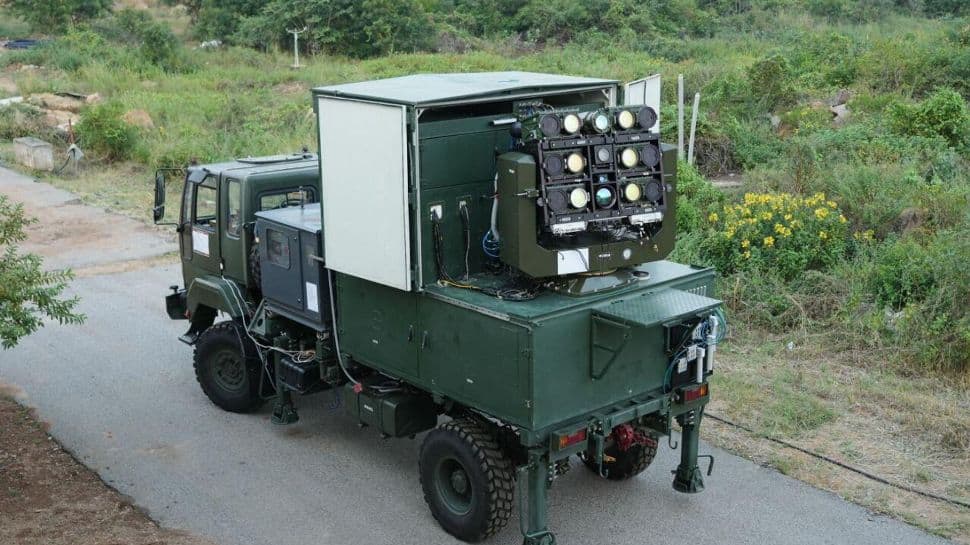
India is rapidly advancing its defense capabilities by successfully testing its next-generation Directed Energy Weapon (DEW), the 30-kilowatt Mk-II(A) laser system. This significant achievement places India among global leaders like the US, China, Israel, and Russia in the cutting-edge field of laser weaponry.
The DRDO’s Mk-II(A) demonstrated remarkable precision during its April 2025 test in Andhra Pradesh, neutralizing stationary targets, drone swarms, and surveillance sensors at a range of five kilometers. This success marks a crucial step towards equipping India with advanced defense technologies for modern warfare.
Directed Energy Weapons, which utilize concentrated energy beams, offer a significant advantage over traditional ammunition-based systems. Their primary benefits include extremely low per-shot costs and near-instantaneous response times, making them ideal for countering fast-moving threats like drones and rockets. The Mk-II(A)’s development signifies India’s commitment to staying ahead in this technological arms race.
While the current 30-kilowatt system is not designed to intercept ballistic missiles, it represents a foundational capability. India is also working on a more powerful 300-kilowatt ‘Surya’ DEW, projected to intercept high-speed missiles up to 20 kilometers away. This ambitious project aims to bolster India’s air defense against evolving aerial threats, particularly from neighboring countries.
DEWs operate by employing concentrated energy, such as lasers, microwaves, or particle beams, to disable targets. Lasers can generate intense heat to melt or destroy critical components, while microwave systems can neutralize multiple drones over a wide area. The technology promises cost-effectiveness, rapid engagement, and reduced collateral damage, making it a strategic asset for national security.