
Breastfeeding: The Newborn's First Protective Shield and its Social Importance
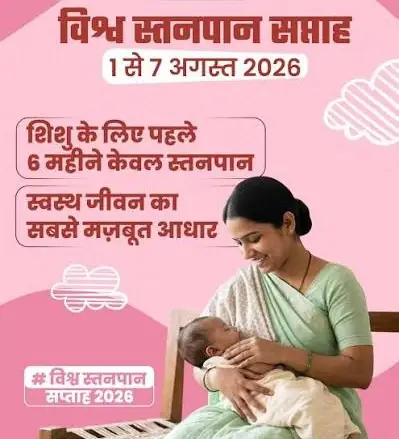
Mother's milk is the newborn's first dose of immunity.
Mother's first thick yellow milk is like nectar.
By Dhananjay Rathore, Joint Director, Public Relations
Raipur, World Breastfeeding Week is celebrated every year from August 1 to 7. Its main objective is to make people aware of the importance of mother's milk for infant health. Starting breastfeeding within the first hour of birth and exclusively breastfeeding for the first six months is most crucial for the baby. Skin-to-skin contact during breastfeeding strengthens the emotional bond between mother and child, providing comfort, warmth, and a sense of security that aids in healthy emotional development.
Breastfeeding protects infants from life-threatening infections.
Every year from August 1 to August 7, World Breastfeeding Week is celebrated worldwide. The main objective of this event is to make mothers and society aware of the importance of breastfeeding for infant health. According to the World Health Organization and UNICEF, the first hour after a baby's birth and the first six months play the most decisive role in shaping their entire life. Breastfed infants have a reduced risk of common childhood illnesses such as diarrhea, pneumonia, ear infections, and some respiratory infections. According to the World Health Organization (WHO), optimal breastfeeding has the potential to prevent millions of infant deaths globally each year by protecting infants from life-threatening infections.
First thick yellow milk (colostrum) is like nectar.
In the first few hours after birth, mother's milk is not just food, but the newborn's first dose of immunity, which directly passes from the mother's body to the baby. The first hour after birth, often called the Golden Hour, is extremely important for initiating breastfeeding. During this time, babies are naturally alert and instinctively seek the breast. Early skin-to-skin contact not only increases the success rate of breastfeeding but also helps regulate the baby's temperature, heart rate, and blood sugar levels.
Mother's first thick yellow milk, called colostrum, immediately after the baby's birth (within one hour), is the baby's first natural vaccine. It is rich in antibodies, proteins, and vitamins, which strengthen the newborn's immunity and protect it from various infections.
Exclusively breastfeed for the first 6 months
Doctors and health experts strongly advise that babies should be exclusively breastfed from birth up to 6 months of age. During this period, there is absolutely no need to give the baby water, formula milk, or honey, as mother's milk contains water and all essential nutrients in the right proportion to quench the baby's thirst and hunger. After completing 6 months, breastfeeding can be continued while gradually introducing complementary nutritious food, which can be continued for 2 years or more.
Multifaceted benefits of breastfeeding
Breastfeeding is a health boon for infants, significantly reducing the risk of diarrhea, pneumonia, ear infections, and malnutrition in children. Studies have proven that breastfed children have better intellectual development and mental health compared to other children. It further reduces the likelihood of chronic diseases such as obesity, diabetes, and asthma in children.
Beneficial for mother's health
Breastfeeding reduces the risk of breast cancer and ovarian cancer in mothers. It helps in postpartum weight loss and the uterus returning to its normal size. An emotional and unbreakable bond is established between mother and child.
Responsibility of society and family
Breastfeeding is not just a mother's responsibility; it is a shared responsibility of the family and society. It is often observed that due to lack of information, social taboos, or lack of facilities in the workplace, women are unable to breastfeed on time. After childbirth, the mother needs proper nutrition, mental peace, and rest so that she can breastfeed the baby without any stress. For working mothers, facilities such as crèche facilities, maternity leave, and breastfeeding breaks at workplaces are essential. Safe and clean feeding rooms should be provided for mothers in public places like bus stands, railway stations, and malls.
Breastfeeding is the foundation of a healthy and empowered generation
World Breastfeeding Week reminds us that we all must work together to create a conducive environment for children to receive their fundamental right to mother's milk. Only when a mother can breastfeed her baby without any hesitation or obstacles can we realize the vision of a malnutrition-free and healthy society.