




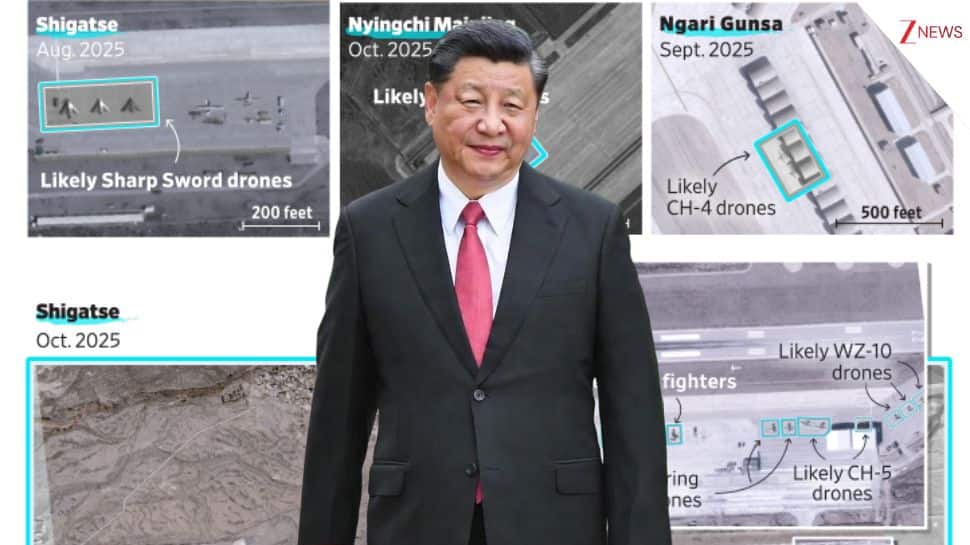
Revealing satellite imagery has exposed a significant military expansion by China along the Indian border, drastically altering regional dynamics. At altitudes reaching 14,100 feet, Beijing has reportedly established three new airbases in Lhunze, Burang, and Tingri. These facilities are equipped to deploy fighter jets, attack helicopters, and surveillance drones, posing a direct threat to Indian airspace. This buildup suggests a strategic maneuver to enhance Beijing’s military presence in the Himalayas.
An investigation analyzing over 100 satellite photographs indicates extensive military development across 16 sites on the Tibetan Plateau. The People’s Liberation Army is enhancing its capabilities with combat jets, drones, and helicopters housed in reinforced structures, effectively turning Tibet into a forward military platform aimed at India. This escalated activity follows previous border tensions, including the 2020 Galwan Valley clash and the 2017 Doklam crisis, underscoring China’s drive to fortify its borders and facilitate rapid troop and equipment deployment.
Unmanned aerial systems are playing a crucial role in China’s surveillance efforts, according to experts. These drones maintain continuous monitoring of the region, tracking Indian military activities and strategic deployments. The development of these ‘sky fortresses’ provides China with a critical speed advantage, enabling the swift movement of troops and heavy weaponry to the border within hours. This enhanced infrastructure tightens Beijing’s control over Tibet and encircles India’s northern frontiers, signaling a substantial shift in the Himalayan balance of power.